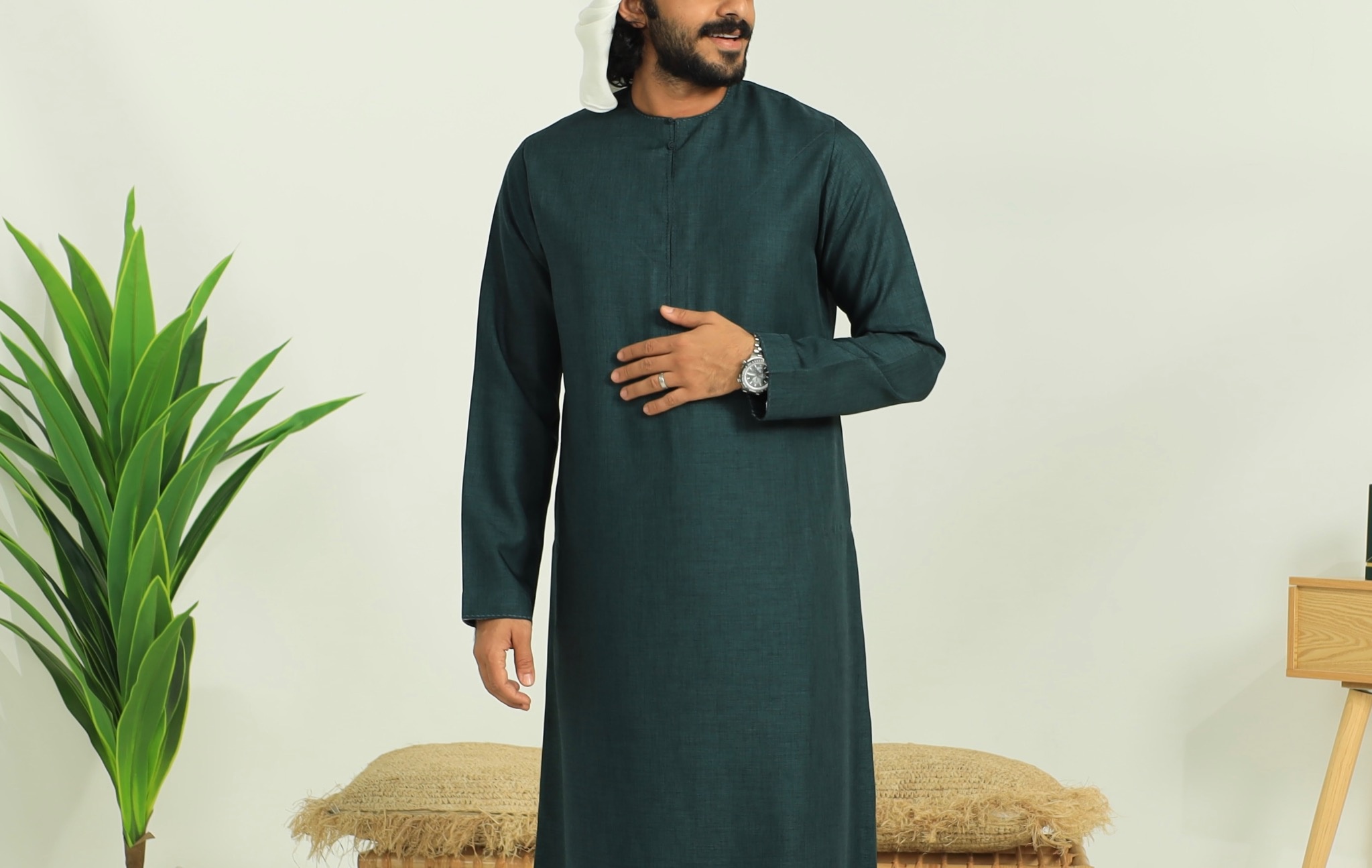
The main types of thobes fall into two families: collar thobes, such as the Saudi, Qatari and Kuwaiti styles, and collarless thobes, such as the Emirati and Omani styles. Within each family, the regional styles differ in the neckline, the front placket, the cuffs, whether there is a tassel, and how close the fit is. Once you know those five details, you can identify most thobe styles at a glance.
This guide covers what each style looks like and when it suits. If you are wondering why the same garment is called a thobe, thawb, kandura, dishdasha or jubba, our post on thobe vs kandura vs jubba covers the names, so we will stick to the styles here.
Every regional style has local variations, and tailors in each country interpret them differently. The descriptions below are the typical features most people recognize, not strict rules.
The Saudi thobe is the style most people in the US picture first. It typically has a structured, shirt-style collar, a front placket and shirt cuffs, and it is cut fairly close through the chest and shoulders for a tailored look.
A classic detail is a front flap that covers the placket buttons, giving a clean, uninterrupted front. White is the everyday and summer color, and darker tones are common in cooler months.
Our M73 White Saudi Collar Thobe ($59.99) follows this classic Saudi collar with a front flap, and you can see the full Saudi thobes collection online.
Choose it when you want a sharp, formal look: Jumu’ah, Eid, work events, a nikah. It is also the easiest style for men who are used to dress shirts, because the collar and cuffs feel familiar.
The Emirati style is collarless, with a clean round or slightly rounded neckline and a short front opening. It is typically longer and looser than a Saudi thobe, with plain sleeves rather than shirt cuffs.
A traditional Emirati detail is a long tassel, often called a tarboosha, hanging from the neckline. Many Emirati thobes also carry fine embroidery around the neck and down the opening. White is the classic color, with softer and darker tones also worn.
Our Emirati styles focus on the clean neckline and embroidery. The M121 Black Emirati Thobe With Gold Embroidery ($69.99) is in Japanese cotton with understated gold embroidery, and the M120 Green Emirati Thobe With Gold Embroidery ($69.99) offers the same cut in green. Browse every option in our Emirati thobes range.
It is a strong choice for Eid, family gatherings and warm weather, and for men who find a collar restrictive. The relaxed cut moves easily through a long day of visits.
The Omani style is also collarless, with a round neckline and a relaxed, comfortable fit. Its signature is a short tassel at the neck, often called a furakha, which is traditionally sometimes scented with perfume or oud.
Omani thobes often feature embroidery around the neckline, and they are worn in a wider spread of colors than many Gulf styles. Soft blues, greens, pinks and earthy tones are all familiar.
Our newest style, the M131 Green Omani Thobe ($94.99), has a collarless Omani cut with a detachable tassel, in our wrinkle-resistant fabric. The relaxed M119 Aqua Blue, M123 Dusty Pink and M124 Light Green Omani thobes are $69.99 each. See them together in our Omani thobes collection.
Pick it for summer, Eid, weekends and any time comfort comes first. The color range also makes it the most expressive of the classic thobe styles.
These are worth knowing so you can recognize them, although Al Aniq does not make these specific regional styles. Each varies between tailors, so treat these as general descriptions.
The Kuwaiti dishdasha is often described as having a softer collar than the Saudi style, a short buttoned placket and a straight, roomier cut. Cuff styles vary from tailor to tailor.
The Qatari thobe usually has a shirt-style collar and a long front placket, often with concealed buttons, plus shirt cuffs that many men wear with cufflinks. The look is crisp and formal.
The Bahraini style is generally relaxed in fit, with a modest collar or rounded neckline. It shares features with its neighbors and varies widely by tailor.
This is the decision that matters most. A collar thobe looks more formal and structured, works well under a jacket and suits men who like a defined neckline. A collarless thobe feels lighter, cooler and more relaxed, and suits warm weather and long, informal days.
If you only own one thobe, we usually suggest a collar style for versatility. Our best-selling US thobe, the M113 White Collar Thobe With Gold Embroidery, is a good example. Add a collarless Omani or Emirati thobe as your second. You can compare the structured styles in our collar thobes range.
| Style | Neckline | Placket | Cuffs | Tassel | Typical fit | Best for |
|---|---|---|---|---|---|---|
| Saudi | Structured shirt collar | Buttons, often under a front flap | Shirt cuffs | No | Tailored | Jumu’ah, formal events, work |
| Emirati | Collarless, clean round neck | Short opening | Plain sleeves | Traditionally a long tassel | Long and relaxed | Eid, family visits, warm weather |
| Omani | Collarless, round neck | Short opening | Plain sleeves | Short tassel at the neck | Relaxed | Summer, Eid, weekends |
| Kuwaiti | Softer collar | Short buttoned placket | Varies | No | Straight and roomy | Everyday wear |
| Qatari | Shirt-style collar | Long placket, often concealed buttons | Shirt cuffs, often cufflinks | No | Crisp, tailored | Formal occasions |
| Bahraini | Modest collar or rounded neck | Varies | Varies | No | Relaxed | Everyday wear |
A Saudi thobe typically has a structured collar, a buttoned placket and shirt cuffs with a tailored fit. An Emirati thobe is collarless with a clean neckline, plain sleeves and a longer, looser cut, and traditionally has a tassel at the neck.
The short tassel at the neck of an Omani thobe, often called a furakha, is a traditional decorative detail. It is sometimes scented with perfume or oud. On our M131 Green Omani Thobe the tassel is detachable.
Neither is better overall. A collar thobe looks more formal and suits Jumu’ah, work and weddings, while a collarless thobe feels cooler and more relaxed for summer and family gatherings.
For most men, a collar thobe in white or a dark color is the most versatile first thobe. It works for prayer, Eid and formal events and looks neat under a jacket.
Yes. Many men around the world wear Omani and Emirati cuts simply because they like the look and comfort. Wearing one respectfully and well-fitted is what matters.
Ships the same day from our US warehouse: $10 shipping (free over $150), delivered within 3 business days, no customs fees, and easy returns and exchanges within 14 days. We also ship to Canada for $15.
Share this post with your friends